
Vertex Form Solver
The vertex form of a quadratic, y = a(x − h)² + k, puts the most useful information on display: the vertex (h, k), the direction the parabola opens and how steep it is. This page shows how to convert any quadratic to vertex form, works through examples, and describes a pack of printable practice worksheets with complete answer keys.
- Instant download
- Editable Word & Excel
- Print-ready PDF
- 7-day refund
7 files · PDF, DOCX, XLSX
Vertex Form Worksheet Pack
Six vertex form worksheets (60 problems) with full answer keys, parabola graph paper, a formula reference card and an Excel converter for checking.
- Standard → vertex (PDF/DOCX)
- Vertex → standard (PDF/DOCX)
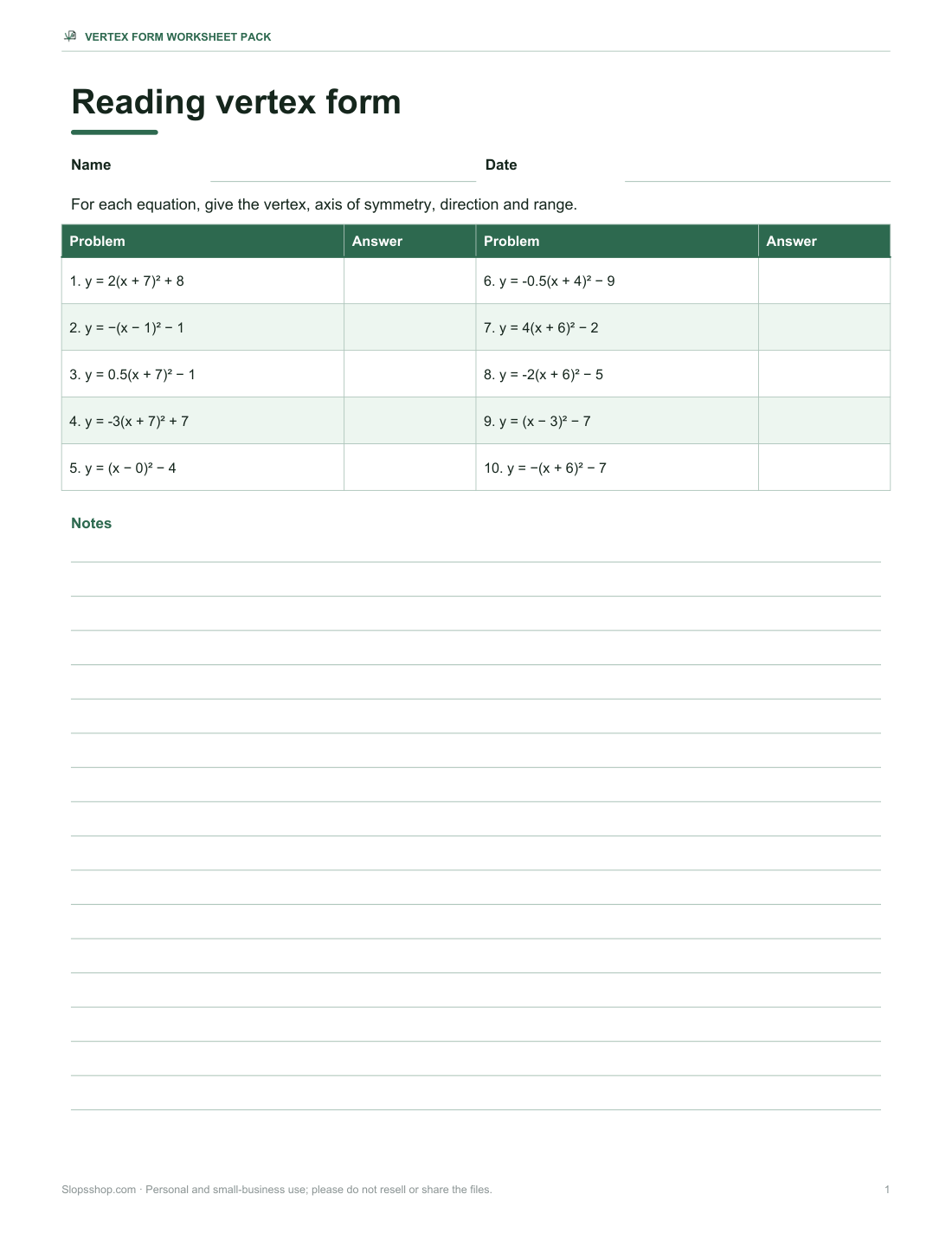
- Vertex, axis, range (PDF/DOCX)
- + 4 more
$5.00 USD, one-time 7 files · about $0.71 each
- Instant download
- 7-day refund
- Secure checkout by Stripe
✓ Classroom use included
7-day money-back guarantee. Full refund within 7 days of purchase, even after you download.
Free sample: Standard to Vertex Form (PDF, 100 KB)
License: personal and classroom use. Teachers may print and photocopy these files for the students in their own classes, and share them in a password-protected class space (e.g. Google Classroom). Please do not resell, redistribute, or post the files on public websites. One purchase covers one teacher.
Vertex Form Worksheet Pack
Six vertex form worksheets (60 problems) with full answer keys, parabola graph paper, a formula reference card and an Excel converter for checking.
- Standard → vertex (PDF/DOCX)
- Vertex → standard (PDF/DOCX)
- Vertex, axis, range (PDF/DOCX)
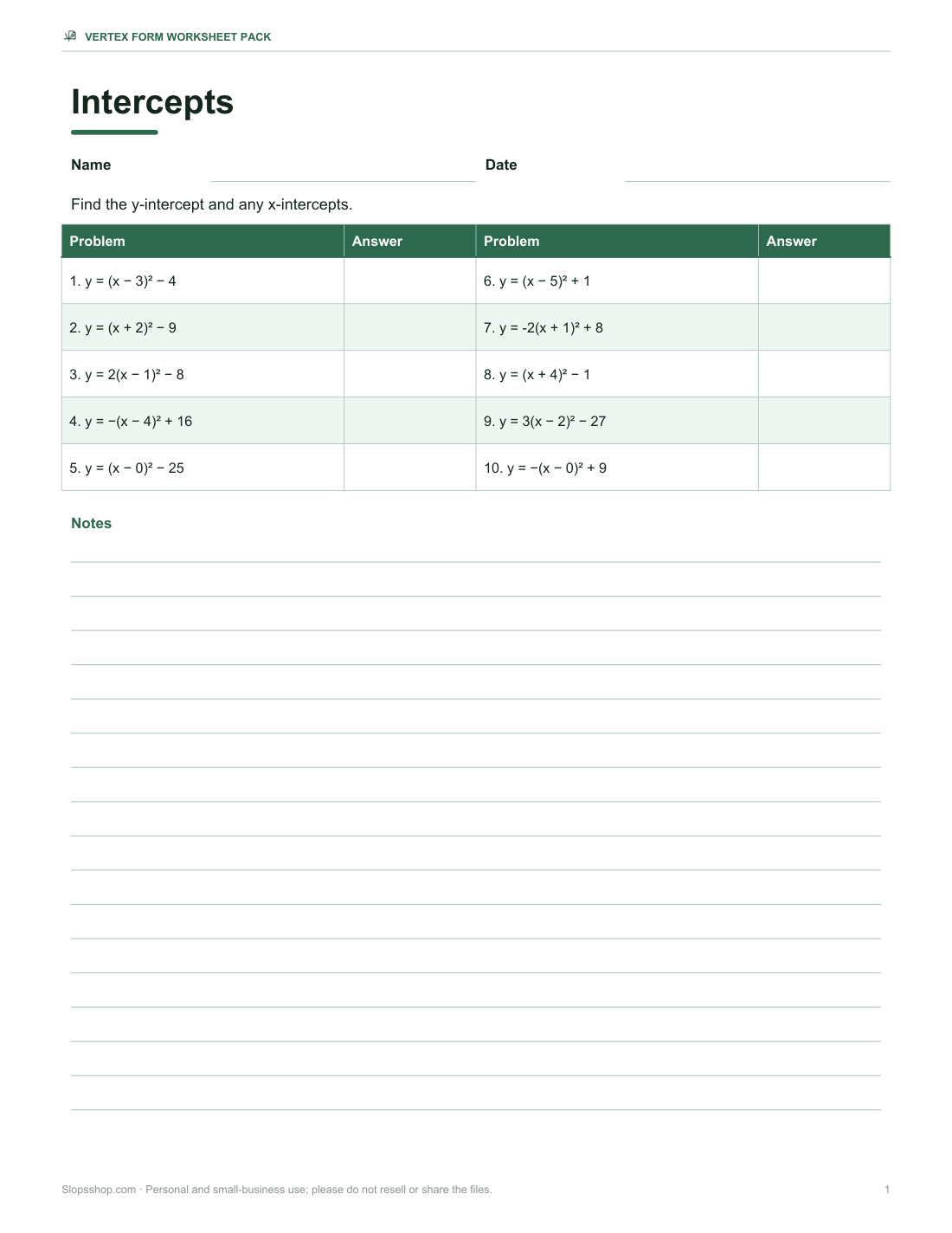
- Intercepts (PDF/DOCX)
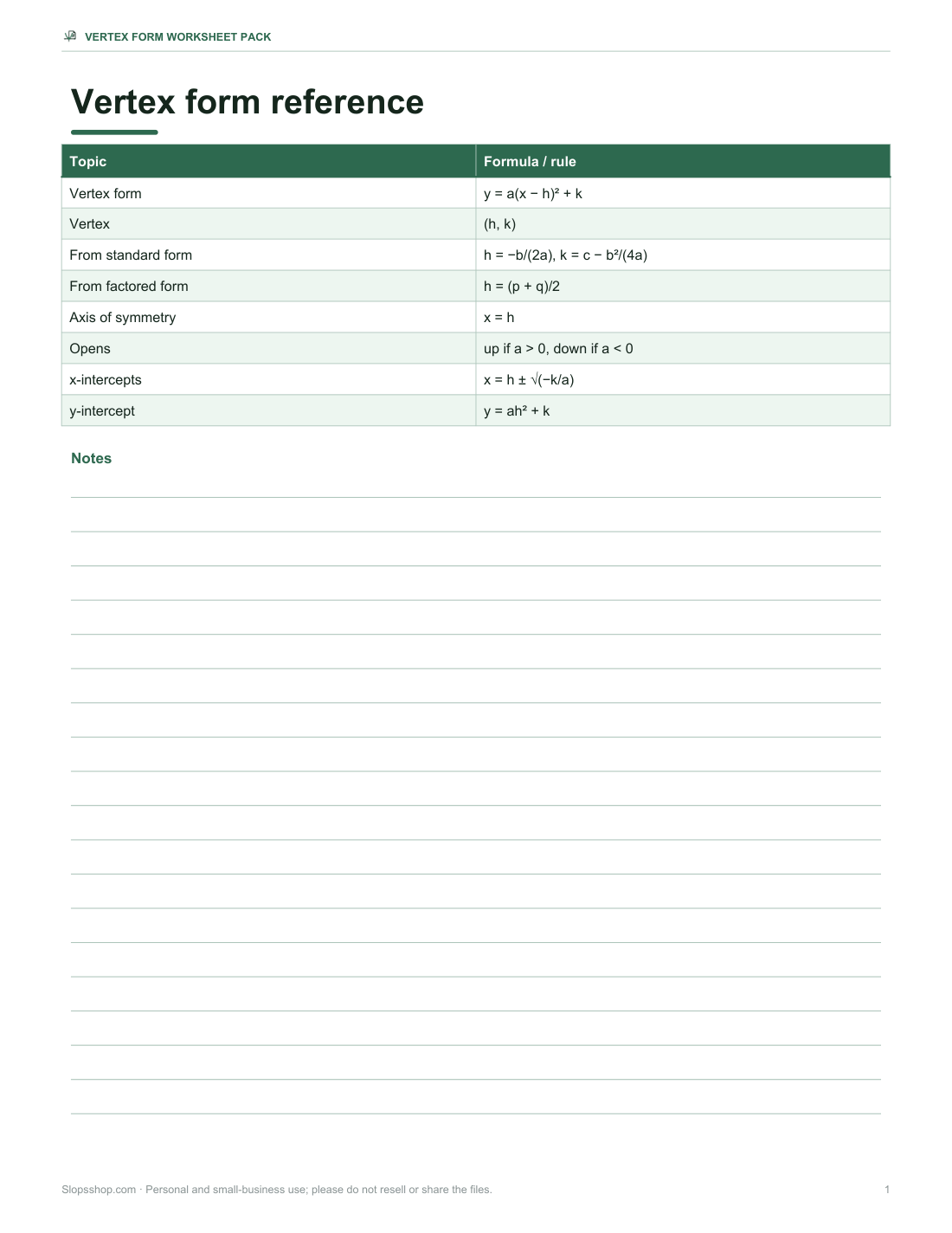
- Reference card (PDF)
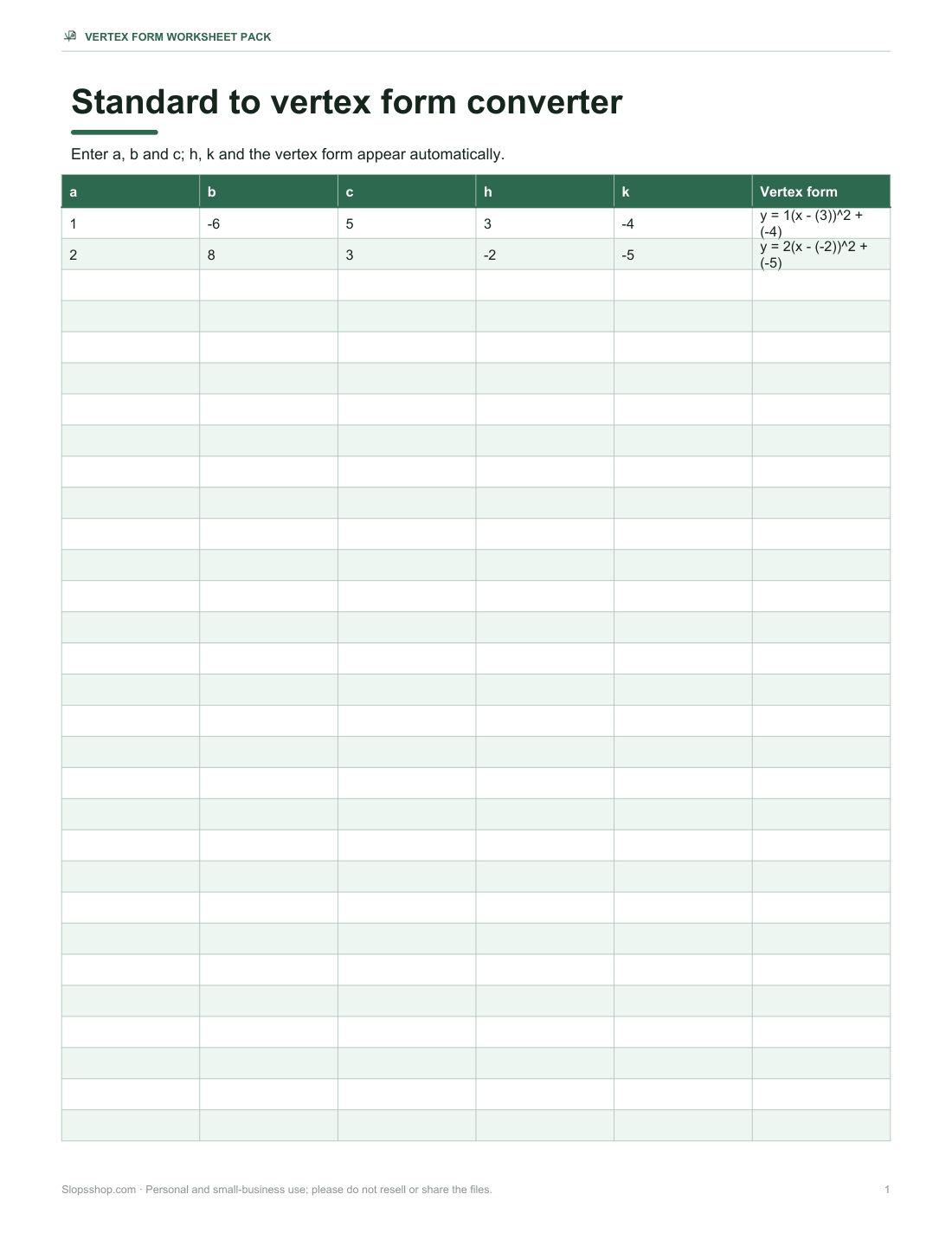
- Excel converter (XLSX)
- Graph paper (PDF)
Formats: PDF, DOCX, XLSX. Instant download after payment (link valid 72 hours, up to 5 downloads). AI-assisted: the templates were drafted with AI help and reviewed and laid out before publishing.
$5.00 USD, one-time 7 files · about $0.71 each
- Instant download
- 7-day refund
- Secure checkout by Stripe
7-day money-back guarantee. Full refund within 7 days of purchase, even after you download.
Free sample: Standard to Vertex Form (PDF, 100 KB)
Full refund within 7 days — see the refund policy and license.
Free printables
Single sheets you can print right now, no sign-up. The full pack adds every sheet in one download plus the editable files.
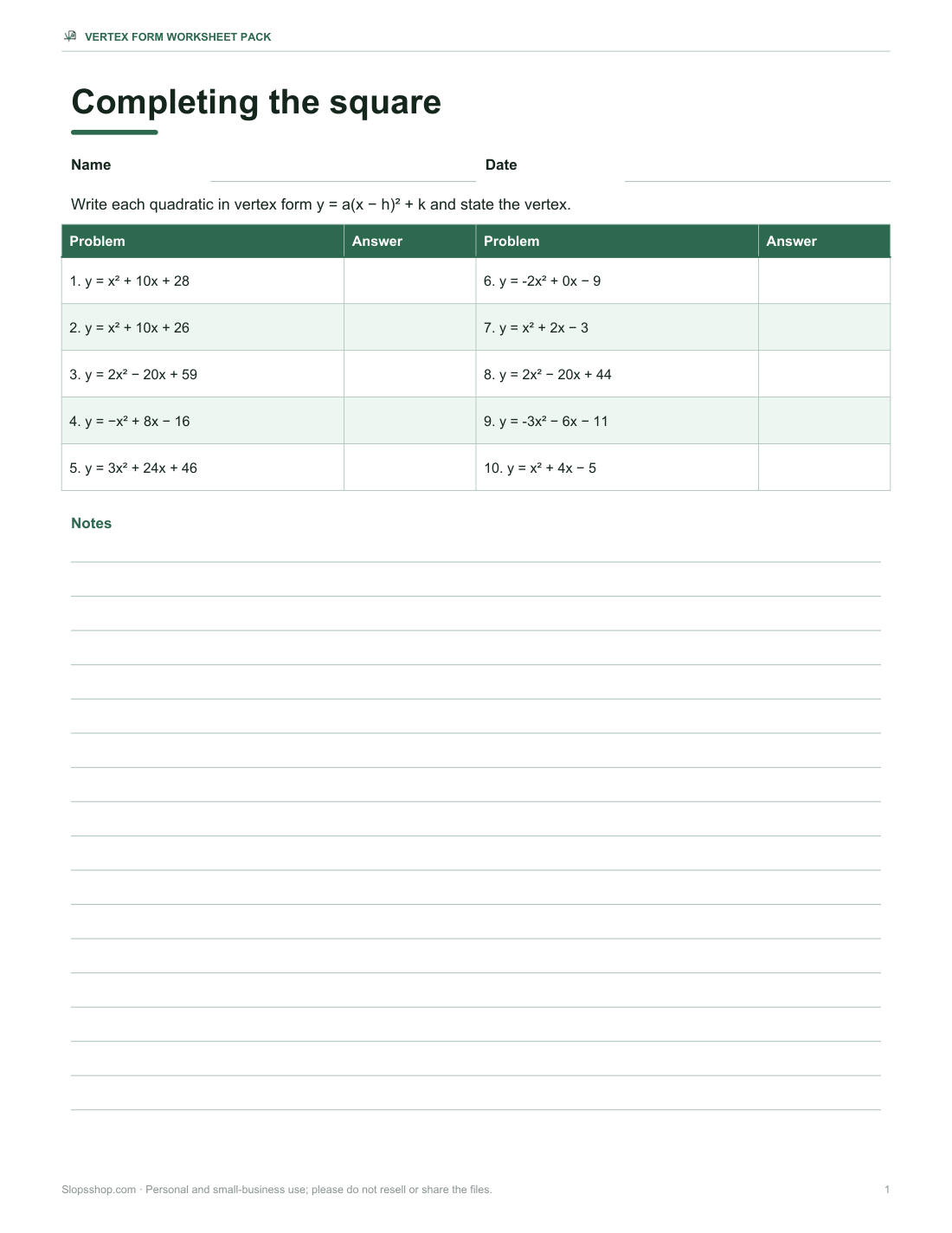
 Vertex Form Completing the Square Worksheet2 pages · free PDF
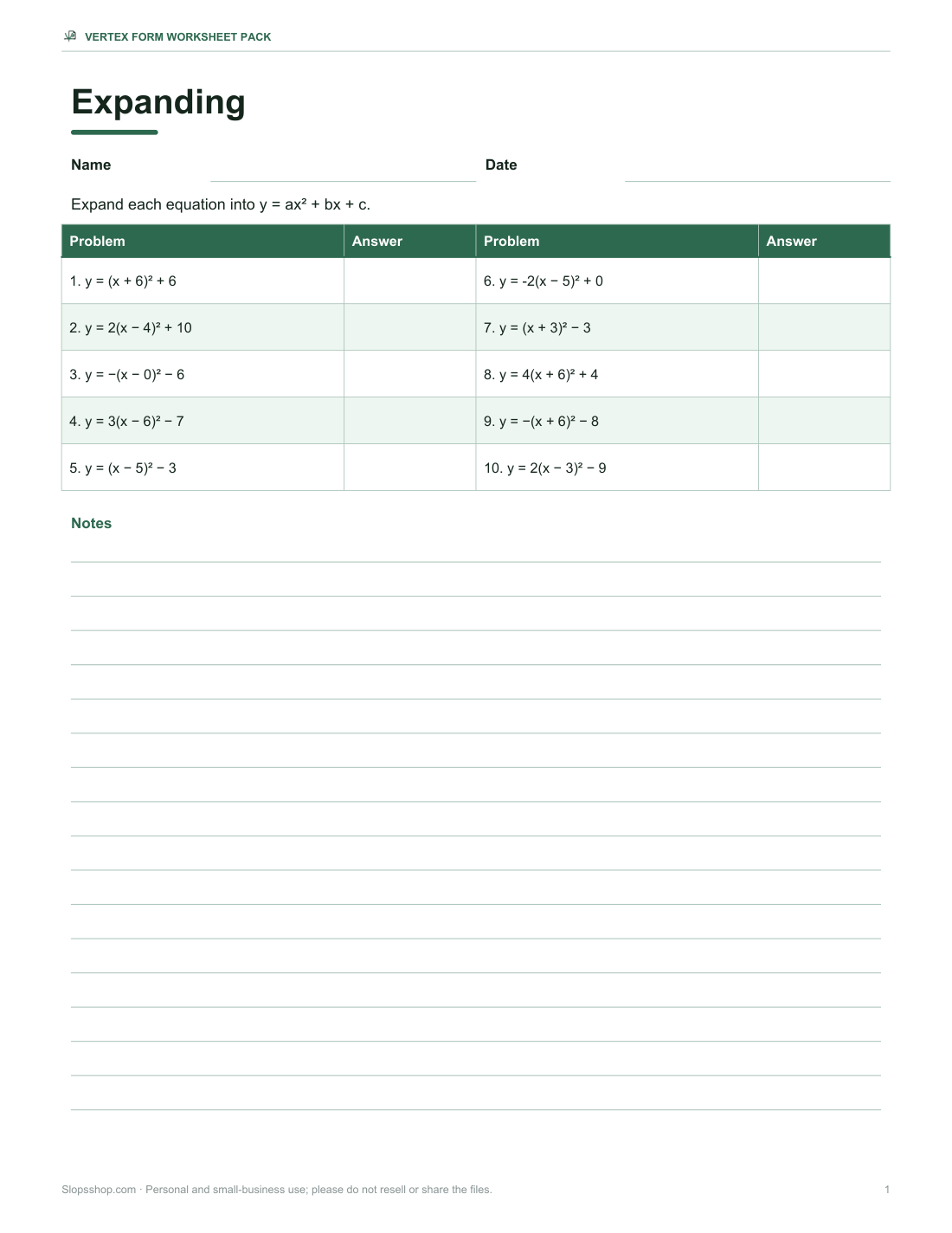
 Vertex Form to Standard Form Worksheet2 pages · free PDF
 Printable Vertex Form Worksheet2 pages · free PDF
 Printable Vertex Form Intercepts Worksheet2 pages · free PDF
 Printable Vertex Form Reference Card1 page · free PDF
 Printable Vertex Form Solver Worksheet1 page · free PDF
 Printable Parabola Graph Paper1 page · free PDF
Vertex form at a glance
| Part | Meaning |
|---|---|
| a | Opens up if a > 0, down if a < 0; |a| > 1 is narrower, |a| < 1 wider than y = x² |
| h | Horizontal shift — the vertex’s x-coordinate (note the minus sign: (x − 3) means h = 3) |
| k | Vertical shift — the vertex’s y-coordinate |
| Vertex | (h, k) — the minimum if a > 0, the maximum if a < 0 |
| Axis of symmetry | The vertical line x = h |
| Range | y ≥ k if a > 0; y ≤ k if a < 0 |
Converting from standard form by completing the square
- Start with y = ax² + bx + c.
- Factor a out of the first two terms: y = a(x² + (b/a)x) + c.
- Add and subtract (b/2a)² inside the brackets.
- Rewrite the perfect square: y = a(x + b/2a)² + c − b²/4a.
- So h = −b / 2a and k = c − b² / 4a.
Shortcut: h = −b/(2a), then find k by substituting h into the original equation.
Worked examples
| Standard form | Vertex form | Vertex | Opens |
|---|---|---|---|
| y = x² − 6x + 5 | y = (x − 3)² − 4 | (3, -4) | Up |
| y = 2x² + 8x + 3 | y = 2(x + 2)² − 5 | (-2, -5) | Up |
| y = −x² + 4x + 1 | y = −(x − 2)² + 5 | (2, 5) | Down |
| y = 3x² − 12x + 7 | y = 3(x − 2)² − 5 | (2, -5) | Up |
| y = 0.5x² + 2x − 4 | y = 0.5(x + 2)² − 6 | (-2, -6) | Up |
| y = -2x² − 8x − 5 | y = -2(x + 2)² + 3 | (-2, 3) | Down |
Take the first: y = x² − 6x + 5. Half of −6 is −3, and (−3)² = 9, so y = (x² − 6x + 9) − 9 + 5 = (x − 3)² − 4. The vertex is (3, −4), the axis is x = 3 and, because a = 1 > 0, the minimum value is −4.
Finding intercepts from vertex form
- y-intercept: set x = 0, giving y = ah² + k.
- x-intercepts: set y = 0, so (x − h)² = −k/a.
- If −k/a is negative, there are no real x-intercepts.
- Otherwise x = h ± √(−k/a).
For y = (x − 3)² − 4: (x − 3)² = 4, so x = 3 ± 2, giving x-intercepts at 1 and 5, and the y-intercept is 9 − 4 = 5 — matching the standard form’s c = 5.
From factored form
If a quadratic is given as y = a(x − p)(x − q), the axis of symmetry is halfway between the roots: h = (p + q) / 2. Substitute h to find k. For y = 2(x − 1)(x − 5), h = 3 and k = 2(2)(−2) = −8, so y = 2(x − 3)² − 8.
Real-world vertex problems
Vertex form answers “maximum” and “minimum” questions directly. A ball’s height h(t) = −4.9(t − 1.5)² + 13 reaches its maximum of 13 m at 1.5 seconds. A business profit model P(x) = −2(x − 40)² + 3,200 is maximised at 40 units, with a profit of 3,200. In each case the vertex is the answer.
What’s in the pack
- Six worksheets (60 problems): standard → vertex, vertex → standard, identifying vertex/axis/range, intercepts, factored → vertex and word problems
- Full answer keys with the completed-square step for every problem
- Parabola graph paper with axes
- A one-page reference card of formulas and transformations
- An Excel sheet that converts ax² + bx + c to vertex form for checking
Worksheets print on US Letter and A4; the spreadsheet opens in Excel and Google Sheets.
AI-assisted content
This page and worksheets were drafted with AI assistance and reviewed before publishing; answers were generated from the formulas and checked.
Frequently asked questions
What is vertex form?
y = a(x − h)² + k, where (h, k) is the vertex.
How do I find the vertex from standard form?
h = −b/(2a); substitute h into the equation to get k.
Why is it x − h?
The graph shifts right by h, so (x − 3) means h = +3.
How do I convert vertex form to standard form?
Expand the square and simplify.
How do I know if the vertex is a maximum or minimum?
Minimum if a > 0, maximum if a < 0.
Is this a subscription?
No, it is a one-time download.
May I print and share these worksheets with my class?
License: personal and classroom use. Teachers may print and photocopy these files for the students in their own classes, and share them in a password-protected class space (e.g. Google Classroom). Please do not resell, redistribute, or post the files on public websites. One purchase covers one teacher.